
Yoga for the Upper Back: Relax Your Slumped Shoulders at Your Desk
Take care of your upper back!
Do you have tense shoulders and no one around to give you a massage? If you work while sitting—and sitting poorly—hunched over your computer screen, your smartphone, or the same document all day, you round your upper back and create tension in the thoracic region of the spine. But a rounded back isn’t just unattractive: this posture puts pressure on the intervertebral discs, pressure that can eventually compress one or both of your sciatic nerves and cause sharp pain.
Did you know that every movement of your head (rotation, flexion, tilting) puts strain on the muscles and bones of your spine all the way up to the fourth thoracic vertebra (the one located right between your shoulder blades)? This means that if you keep your head down looking at your smartphone, you create tension not only in your neck but all the way down to the middle of your back. Women always carry their handbags on the same shoulder out of habit. When you’re stressed, you tense your entire upper body, creating even more tension. The result: sore trapezius muscles, tightness along the shoulder blades, and an even more hunched posture.
So you need to straighten your upper back, strengthen your upper back muscles, and gently stretch them on a regular basis so they can handle the imbalances and tension you put them through without too much pain… Note: we said “build muscle,” not “become a bodybuilder”! You don’t need to lift weights to strengthen your back. So how do you build muscle? Through core exercises! Next, to relax the muscles and release tension, deeply stretch your upper back and shoulders. As luck would have it, yoga is full of exercises to “open up” this part of the back—exercises you can do on your own at your desk.
The Cat and the Cow
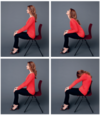
To loosen up all the muscles in your back and get your energy flowing, alternate between arching backward (hollowing your back) and bending forward (rounding your back). Sit at the front of your chair, on your sitting bones, with your back straight. Spread your knees hip-width apart and rest your hands on your knees.
As you inhale slowly through your nose, draw your knees toward you, arch your upper back, and lift your chest up and forward; try to press your shoulder blades together behind your back, roll your shoulders back, and look toward the ceiling. Feel your shoulders draw closer together behind your back, your entire torso stretch from the abdomen, and your ribcage open. As you exhale, press your hands against your knees to round your upper back from the waist, tuck your chin toward your chest, and look at your navel.
You’ll feel the space between your shoulder blades stretching, and you’ll sense the movement in your neck, upper back, and all the way down to your lower back. Alternate between these two movements—opening and closing—five times, breathing deeply through your nose. At the end of the exercise, feel the effect in your back, shoulders, and along your entire spine.
TO BE DONE AGAIN …
- When you've been sitting for too long and feel stiff and rusty
- When you feel tension between your shoulder blades
- When you're feeling tired and need a pick-me-up
- When you have trouble breathing
BENEFITS
- Wakes up and loosens the muscles along the spine
- Gives you a boost of energy
- Helps people with asthma, singers, and those feeling stressed to breathe more easily
WARNING: If you have a neck condition, do not tilt your head back too far.
Handcuffs Behind the Back
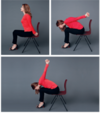
A real challenge for men... because their shoulders are too muscular, of course! Sit at the front of your chair, interlace your fingers behind your lower back, with your palms pressed together if possible. To open up your chest and stretch your shoulders, inhale slowly through your nose, extend your arms, and reach your hands as low as possible toward the floor.
As you exhale, slowly lean forward while keeping your back straight, and raise your hands as high as possible above your head. As you inhale, stay bent forward, but bend your elbows slightly and lower your hands a little to ease the stretch. As you exhale again, raise your arms as high as possible above your head. Repeat this movement 3 times in time with your breath.
At the end of the third exhale, you can remain leaning forward with your arms raised high for 3 long breaths, focusing on the sensations in your arms and shoulders. Inhale and straighten your upper body completely, then lower your hands and rest them on your knees.
TO BE DONE AGAIN …
- When you have muscle stiffness or soreness in your upper back and shoulders
BENEFITS
- Relaxes the shoulder muscles
- Stretches the trapezius muscles
- Helps prevent and relieve tension in the upper back
- Helps improve posture and open up the chest
WARNING: If you have an injury or pain in your shoulders or upper back.
The Wall
The walls in your office can be valuable allies in the fight against back pain. If you work in the middle of an open-plan office, do this exercise in the open space! Stand perpendicular to a wall, with your feet parallel and hip-width apart. Place your right hand on the wall at shoulder height, with your fingers pointing backward and your palm flat against the wall.
Inhale and stretch as far as you can. As you exhale, gently turn your upper body and feet to the left, and look over your left shoulder. Feel the stretch in your right wrist, forearm, and shoulder, and the squeeze in the inner part of your right shoulder blade.
Take 5 very deep breaths, turning your torso as far to the left as possible. At the end of your final exhale, bring your legs and upper body back to the center, and let your right arm hang loosely by your side. Repeat the exercise on the other side.

TO BE DONE AGAIN …
- When you carry a handbag that's too heavy, always on the same shoulder
- When you write a lot by hand or spend your time clicking your mouse
- When muscle tension has built up around your shoulder blades
BENEFITS
- Relieves tension around the shoulder blades and trapezius muscles
- Stretch your shoulders, arms, and wrists
WARNING: If you have an injury or chronic pain in your spine, shoulders, or neck.